Health and Wellbeing
Health and Wellbeing
Explore how work, health, and wellbeing intersect, and discover how organisations can take a strategic approach, engaging leaders, managers, and employees alike, to create a thriving, resilient workforce.
Empowering organisations to embed wellbeing at work
Taking a whole organisation approach to embedding wellbeing into an organisational culture is key to achieving maximum impact. Wellbeing should be positioned as a strategic boardroom issue supporting thriving people, thriving businesses and thriving communities. Business in the Community (BITC) is ready to support your organisational wellbeing strategy with a self-assessment tool, guidelines for workplace wellbeing, and research-backed resources. We also offer a way for leaders to serve as wellbeing champions, impacting policy and responsible business wellbeing strategy across the United Kingdom.

The impact of health and wellbeing in the workplace
in the United Kingdom economy is lost due do presenteeism from mental ill-health, almost twice the cost of absence.
Four in five employees have reported that an inclusive leader has improved their performance and productivity.
still feel unempowered in their roles and would welcome any move to increase their independent authority.
Our wellbeing framework
The Workwell model is our framework for unlocking the full value of employee wellbeing.
It is supported by two key tools: the Workwell Self-Assessment Tool, which helps organisations evaluate their current wellbeing strategies and plan future improvements, and the Workwell Commitment, a public pledge for businesses to prioritise employee wellbeing and follow a clear roadmap for action.
Evidence-based and widely endorsed, the Workwell model places people at the core of organisational purpose, culture, and strategy, driving sustainable health and wellbeing. It offers a unique “gold standard” framework for an inclusive, intersectional approach that empowers individuals, teams, and organisations to thrive
Take action on workplace wellbeing
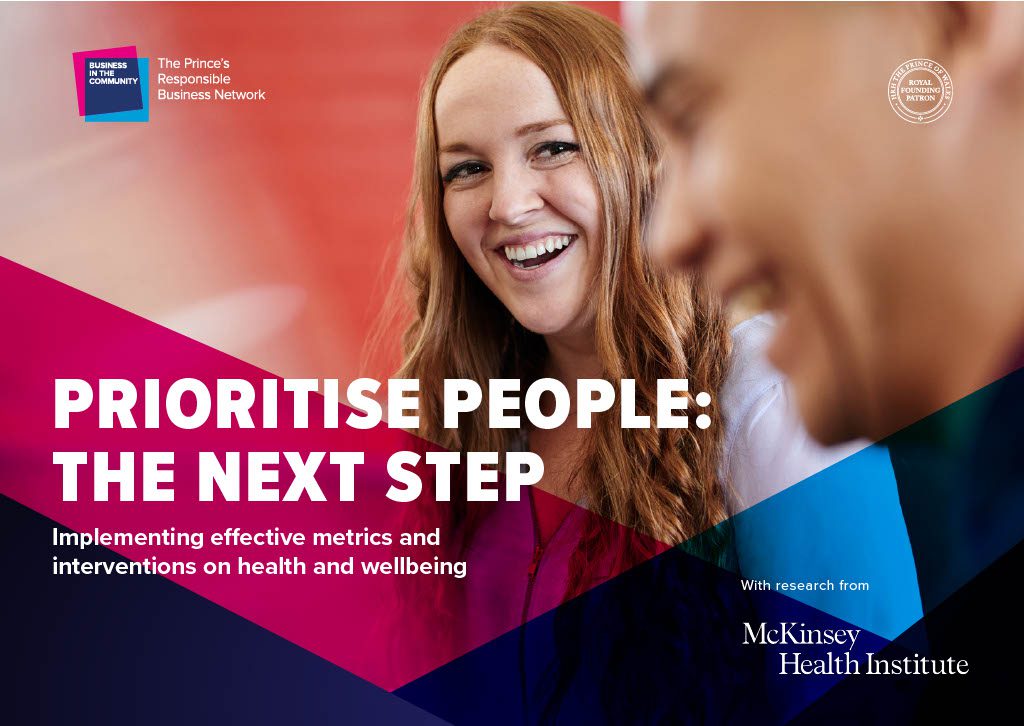
Prioritise People: The Next Step Report
This report, Prioritise People: The Next Step by Business in the Community (BITC) with research from McKinsey Health Institute (MHI), is a practical guide offering science-based measures and interventions that organisations, from large corporations to start-ups, can use to measure health and wellbeing initiatives.
Wellbeing Leadership Team
We work with a network of senior business leaders who champion and provide strategic guidance to shape the areas of action for BITC’s network, building a movement that is committed to positioning health and wellbeing as strategic boardroom issues. Currently, our Wellbeing Leadership Team has a particular focus on mental health. Across wellbeing at work, as a team, our leaders drive collective action on workplace wellness through evidence-based, practical solutions.

Wellbeing at work frequently asked questions (FAQs)
- Establish a benchmark against the Business in the Community (BITC) Workwell Model
- Act to improve the wellbeing of your people
- Measure and report your progress
We ask organisations to establish a baseline by completing the Workwell Self-Assessment and revisiting it annually. Following the first year, your organisation can track the progress of your wellbeing performance through this self-assessment annually. Notification will be sent around the one-year mark, reminding you to resubmit the self-assessment to maintain your signatory status. The Workwell Self-Assessment results from our signatories will be able to offer insights into improvement areas and identify opportunities. We are also considering sharing the aggregated and segmented benchmarking data next year.
It is completely free to sign up for the Commitment.
BITC will:
- Offer the Workwell Self-Assessment Tool to evaluate your wellbeing performance annually, helping you track improvement and identify opportunities.
- Provide access to materials to support your organisation in fulfilling the commitment actions.
- Host online drop-in sessions for sharing knowledge.
- Share newsletters and evidence-based insights.
- Invite your organisation to our annual recognition event, where best practices are showcased.
- Offer advisory services for reviewing your wellbeing performance and strategies (available at an additional cost).
To make the Commitment, your organisation needs to complete the Workwell Self-Assessment Tool. Additionally, we will need secondary contact details and executive approval to complete your sign-up and list your organisation’s name on our website. No other reporting requirements are needed. Maintaining your signatory status requires you to resubmit your self-assessment on an annual basis. A reminder will be sent to you as the one-year mark approaches.
To sign up, complete the sign-up form on our website. Once done, you will receive the survey link for the Workwell Self-Assessment, which you will have to complete if you haven’t already. After completing the survey, you will receive another email asking for secondary contact details and executive authorisation to complete the sign-up process. If you are unable to complete the self-assessment or to provide this additional information within one month after you receive the request, your application will be cancelled and you will need to restart the application process.